



What does youth leadership look like today? A Q&A with Lang Leadership Lab Director Fiona Marshall |
11/20/2026
For Fiona Marshall, leadership is about the process of becoming a leader, not about being a leader. There’s a difference. “Leadership isn’t something that you are, it’s something that you do,” she says.
Marshall is director of the Lang Leadership Lab, a program that, among other things, allows UCC students at every age and stage to discover and develop their personal leadership potential.
Marshall’s own 27-year (and counting) process of becoming a leader in education includes: A master’s in education from OISE; stints creating experiential leadership programs at several schools, including The York School and Havergal College; and absorbing every new study on leadership that makes its way into a journal. The stack of leadership books she plans to read — or reread — is high. (She even listens to audiobooks about becoming a better leader when she jogs.)
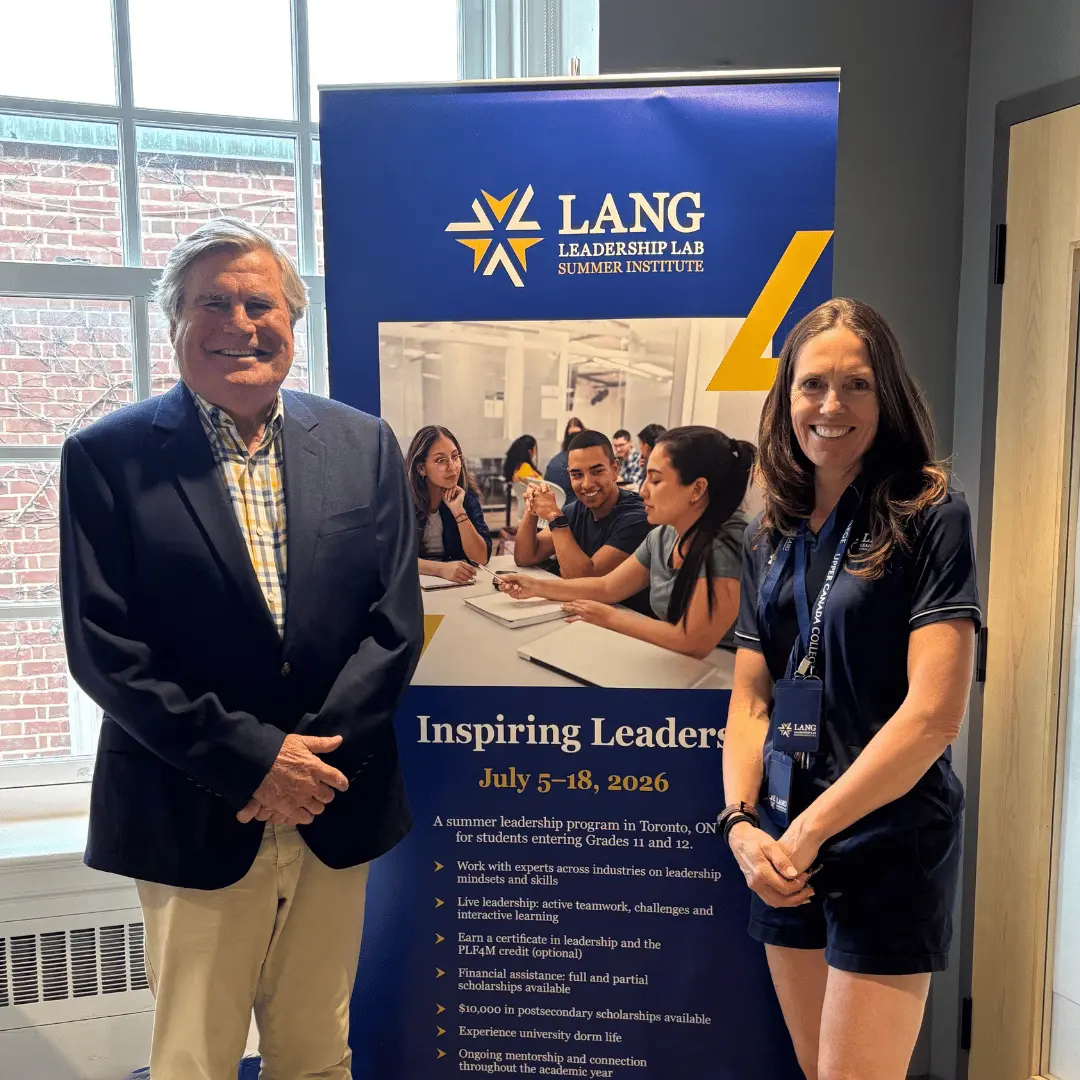
In 2025, Marshall became director of the Lang Leadership Lab’s new Summer Institute, an immersive co-ed program that helps students entering grades 11 and 12 across Canada learn to lead with courage and empathy.
We sat down with Marshall to explore the latest trends in leadership, why investing in young leaders is more important than ever — and what’s next on her to-read list.
You field questions about leadership pretty much daily. What do students want to know?
I get a lot of questions from students about how to productively engage in courageous conversations. It’s tough for anybody — about 70 per cent of people say they’d rather do anything than have a crucial conversation in the workplace.
When coaching students, it’s often about revisiting their grounded confidence: What are your values? What are the experiences you’ve had that can help ground you to do the courageous thing?
A framework we use in our Summer Institute program is: Facts, Story, Ask. We start by looking at one or two indisputable facts about the situation that were seen and heard, and that all parties would agree to. Then it’s, “What is the story I’m telling myself about what those facts mean? What narrative have I constructed?” And finally, the “ask” means turning things around by asking, “What is your perspective?”
One of our students used this approach to have a challenging conversation with her parents — and she said it was transformational. She told me it was the first good conversation they’d had in a while, one where she felt listened to and where she also understood a different perspective.
Is there a trending leadership topic that you’re particularly interested in?
I actually just listened to a great interview with Aiko Bethea, an expert in leadership who focuses on accountability. We talk a lot with young people about accountability because, of course, they make mistakes all the time. We all do.
When we talk about integrity as one of our five core mindsets of leadership, we have to include accountability within that. Bethea’s work on accountability is about holding yourself accountable for the space between intent and impact, rather than just on the intent itself.
For instance, kids often hang onto the intention: “Well, I didn’t mean that. That’s not what I meant to do.” The idea of owning that space in between and taking responsibility for our impact is a really interesting framing to think about.
What’s currently at the top of your list of books about leadership — any recommendations?
I love Adam Grant at the Wharton School at the University of Pennsylvania. I think his work is excellent. (His latest book is Vibe: The Secrets of Strong Connections in a Lonely World.)
I’m just finishing The Inner Game of Tennis, which is a book about tennis, but it’s not really about tennis. It’s a great book on leadership and about how we master ourselves, coach others and develop self-awareness.
I’m also a big Dare to Lead fan; I believe in the work Brené Brown does. And I love Jim Collins’s work, Good to Great. It’s business-focused, but there are great lessons in there. Oh, and Angela Duckworth, who wrote Grit, just came out with a new book called Situated, which is on my holiday reading list. I could keep going… it’s a long list!
The Lang Leadership Lab Summer Institute: What made you think, “We need to do this”?
The opportunity to invest in young Canadian leaders — to give them the confidence, courage and self-awareness to go out and lead with empathy and integrity — is very appealing to me. There are a lot of programs out there where kids come out with a product at the end, like creating a charity. And that’s amazing, but our “product” is the human being.
Our work is based on the idea of, “Who is the human graduating from this program, and how can that human go out and positively impact other humans through leadership?” That human level of leadership is even more vital with the rise of AI.
I also wanted to bring in students who have fewer opportunities for these kinds of enrichment programs. If we consider the pluralism of Canada, we have an obligation to create environments where students with totally different lived experiences can come together to learn how to lead together.
And all of this is happening thanks to the generosity of Stu ’70 and Kim Lang. Stu is an integral partner and supporter, and an enormous inspiration to me. He leads in all the right ways: with empathy, curiosity and integrity. None of this would exist without him.
Why is the Summer Institute so important right now?
I worry a lot about young people. Many of them feel they have no agency, power, or autonomy over a future that just seems to be racing at them.
If we can empower kids to realize that they have value and that they can lead in the face of whatever they confront, I hope it helps them feel more hopeful. The world is changing at an exponential rate for young people. Agility, adaptability, embracing failure and understanding resilience are a huge part of what we do at the Summer Institute. Courage means trying it out, messing it up, getting back up — and trying it again.
What do you most want people to know about today’s young leaders?
That young people are so freaking awesome! They can do such hard things, especially if you take away judgment and truly believe in them. Young people crave time to understand themselves and to connect deeply with others from a place of authenticity. With that experience, they feel empowered to face any challenge. They’re going to lead their lives, and that’s what I want for them.
— Sydney Loney