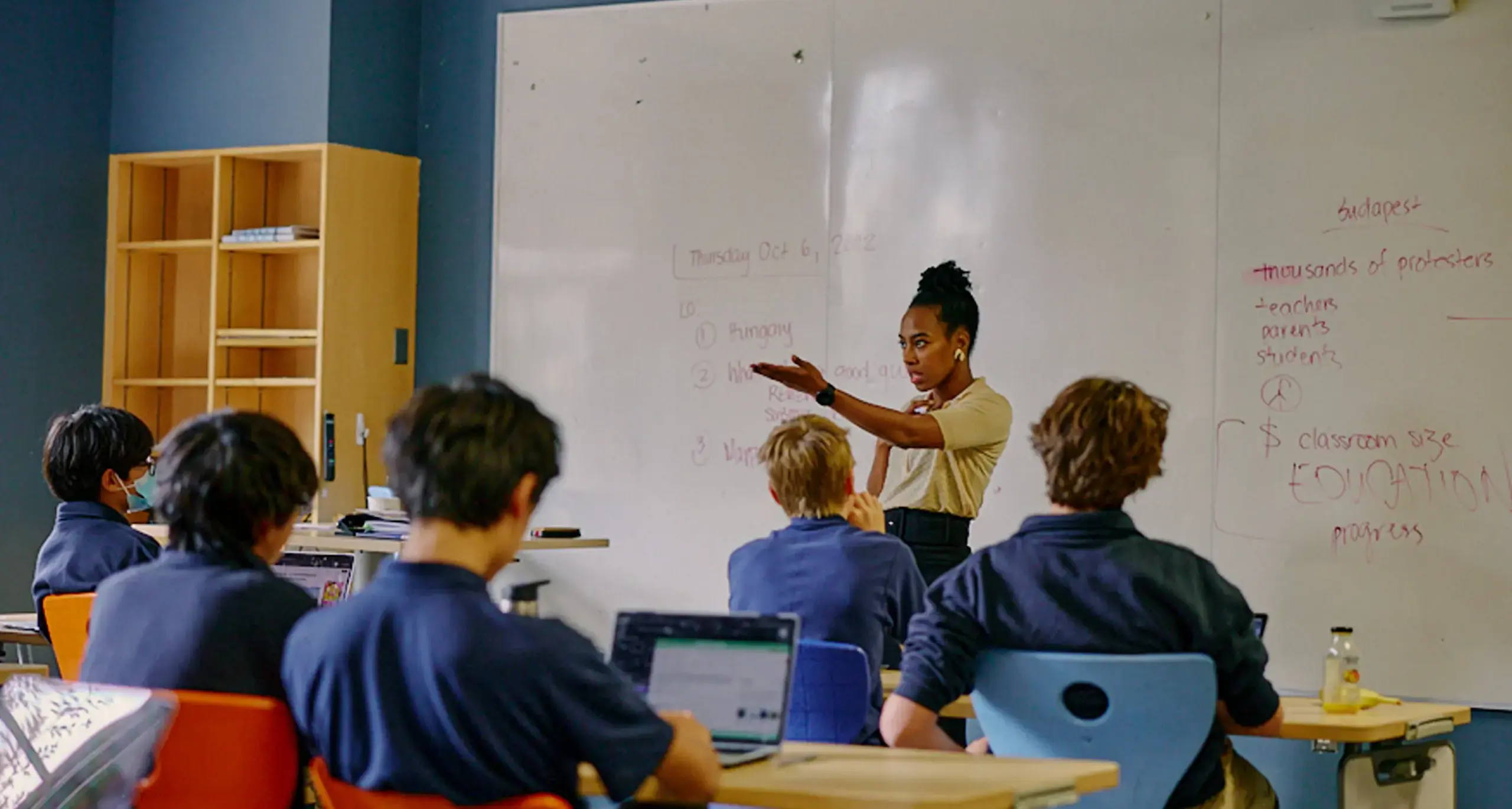
Explore our campus, hear from members of our Senior Leadership Team, meet our dedicated faculty and students, and learn about the International Baccalaureate (IB) programme.
Before starting your application, it’s important to determine if UCC is a good fit for your family. We encourage all families to learn more about our programs and stay connected to the school. To find out more about UCC and what makes us truly stand apart, start your exploration at the About UCC page.
What are you looking for in an applicant?
We look for students who represent a broad range of experiences and backgrounds and who, with the support of their family, demonstrate the motivation to get involved in UCC and school life. Successful applicants show strengths in three different developmental areas:
ACADEMIC
Your child is not expected to know everything. While we require a solid foundation in English literacy and numeracy, we also look for potential and a willingness to listen, learn and embrace challenges.
CO-CURRICULAR
Your child has a spark. We look for a cross-section of talent – in arts, athletics and other activities – and students with potential to contribute to school life beyond the classroom.
SOCIAL-EMOTIONAL
Your child is an individual and part of a larger group. We look at social skills and overall self-regulation – inside and outside the classroom. Above all, we consider the whole child.
What are the actual annual costs above and beyond tuition?
While tuition covers most curricular costs there are some incidental charges which are not covered. Please visit the Tuition and Financial Assistance page to get a better idea of what the total cost may be per year. PLEASE NOTE: these charges will vary from student to student.
Curricular Program
What courses do you offer at each grade level?
For detailed information please visit the Academics section.
What school and/or academic program do you recommend as preparation for UCC?
We do not recommend any one school or program for UCC prep. We admit a wide variety of boys from different educational backgrounds who meet UCC’s academic, co-curricular and social skills criteria. Parents should always choose a school based on “fit” — the school that will best meet the needs of their family.
What is the philosophy behind all boys’ education?
Many studies have shown that the traditional co-ed classroom setting does not favour boys nor does it support their learning styles. Our faculty have become experts in boys’ education, through professional development opportunities and research conducted by our own Centre for Learning. For more information and research on the benefits of boys' schools, visit the International Boys' School Coalition website.
What technology is used in the classroom?
UCC is a one-to-one school, with a school-supplied iPad used in the SK-4 classrooms and Macbook used in Year 5 to Year 12. Students receive UCC technology loaded with all the programs and applications required to support their curriculum, plus our IT HelpDesk is available to support and troubleshoot as needed. Our investment in technology includes interactive whiteboard technology, wireless projection, streaming cameras, and multi-direction microphones in all classrooms.
Can you accommodate students with learning differences?
When applying, we ask that you provide a current Psychological Educational Assessment so that we can assess your student’s needs and what support we can offer.
Do you offer a gifted program?
UCC's delivery of the IB programmes is academically rigorous and challenges students.
Do you offer a French Immersion program?
We do not offer a French Immersion program at UCC, although French is taught as a second language in all grades. Students arriving into Year 6 and 7 are placed in one of three streams: Core Basic, Core Advanced and Extended. Most students will follow our Core French program at either the Basic or the Advanced level. Some students will be recommended for the Extended French program on the basis of a demonstrated strong background, fluency and skills in the language. At the Upper School, students need to study French for at least one year in Year 8. In Year 9 they can continue with French or choose Latin, Spanish or Mandarin and continue with this language until Year 12.
What are the expectations around English language proficiency? Does UCC have an ESL program?
At UCC, the language of instruction is English and therefore students need to demonstrate proficiency in English. UCC does not have a formal ESL program; however, the Wernham West Centre for Learning provides a great deal of support for English language learners, including some boarding students.
How does UCC acknowledge Canada’s Indigenous population in its programming?
Over the years UCC students have welcomed First Nations guest speakers, visited First Nations and Inuit communities, and discussed Indigenous Peoples and the issues they face in a variety of contexts. Here are some current examples of how UCC recognizes and pays respect to Canada’s Indigenous population:
In a Year 5 unit of inquiry, the central idea is that “people have different perspectives that influence interactions,” and students explore the features of Indigenous societies.
In Year 7 history and geography, the relationship between European explorers and Indigenous societies is a main topic of discussion. A specific unit and assessment is dedicated to the students' understanding and impact of the Residential Schools.
In Year 8 and Year 9 English, students participate in an exchange with Manitoba high school students where written pieces focusing on personal experiences are shared and used to start a dialogue about First Nations history, identity, and culture.
In Year 11 Language and Literature, students learn about residential schools through documentaries, editorials, poems, political cartoons, testimonials, and newspaper articles.
UCC’s Amnesty International club raises awareness for missing and murdered Indigenous women and girls.
At both the Prep and Upper Schools, an Acknowledgment of Traditional Land is read aloud at the beginning of special assemblies and events.
Where do students go for post-secondary education?
Students work with our University Counselling Office to learn about schools and programs that best fit their educational goals. University counsellors assist students to put together applications, prepare for entrance requirements and decide, ultimately, which school will be their ideal match. UCC graduates are well prepared to study in Canada, the United States and abroad. Every year, we have a number of students who choose to attend prominent schools in the United States and around the world.
How many graduates receive university offers?
All of our graduates receive offers to university or college, partly on the strength of the internationally recognized IB Diploma. Our 2023 graduates, for example, received more than 800 offers of admission to 147 universities in Canada as well as the United States, the United Kingdom and Europe — graduates will be attending 53 distinct universities around the world.
Safety and Transportation Concerns
Are UCC’s teachers Ontario certified?
We currently have 151 teaching staff at Upper Canada College, including residential assistants, Norval outdoor educators, and After School Program staff; 140 have the Ontario teaching certificate.
Are UCC faculty and staff screened to ensure they are qualified to work with children?
UCC has a rigorous hiring process and a dedicated HR department to oversee it. Job applicants who are selected for an interview are questioned by current staff members in the related department as well as a senior administrator. Once the successful candidate is chosen, reference checks are done with previous employers. If those meet our requirements, we require a previous satisfactory criminal reference and “vulnerable sector screening,” and request a new one from the police. New checks take up to two months to process, so we ask for a previous one as insurance. UCC strives to provide a positive, humane and safe environment for students, faculty and staff — a community that supports the dignity, wellbeing and safety of all its members. Employees are trained in standards and boundaries for working with children, and they are guided by the comprehensive UCC Policy andProcedures for Preventing, Identifying and Investigating Harassment, Abuse and Violence.
Is there a bus my child can take to and from school?
We do not offer any bus or shuttle services. Some private transportation companies service UCC, and some families carpool. In addition, UCC is close to public transportation, including bus, streetcar and subway lines.
Financial Assistance
Who is eligible for financial assistance?
Assistance is available to Canadian citizens starting in Year 5, and we encourage all eligible families to apply.
How do we apply for financial assistance?
The application for financial assistance is separate from the application for admission. Both must be submitted in order to be considered for financial assistance. Candidates wishing to apply for financial assistance must complete and submit the Financial Aid for Canadian Students (FACS) application form available via the Apple Financial Services website. The fee for applying is $137.50 and regretfully we do not offer waiver codes for the financial assistance application. All new student financial assistance applications must be completed no later than December 31 to be considered for the following entry year.
How is financial assistance eligibility determined?
Financial assistance is offered on the basis of family need. The Financial Assistance Review Committee (FACS) makes recommendations to UCC based on the information provided by you in the Parents’ Financial Statement. This includes, but is not limited to, the parents/guardians’ gross family income; net income (after taxes and other deductions); assets and liabilities; and information about dependents and other expenditures. The computation is based on a process of analysis developed by a standing committee of experienced financial aid officers. It measures what is possible, though not necessarily comfortable, for a family to contribute toward educational expenses. Schools assume that parents, to the extent that they are able, will bear the primary responsibility for financing their children’s education, sometimes at the expense of other discretionary expenditures.
How do I know if I’ll qualify for financial assistance, and for how much?
There are no predetermined levels or ranges used to determine financial assistance eligibility. We’ve created tools using our current data to help applicant Day families determine whether or not they may qualify for financial assistance. This table offers an at-a-glance look at all current families receiving financial assistance based only on gross family income. The calculator also factors in the number of dependent children in the household. Many other factors impact financial assistance eligibility beyond family income and dependent children. These tools should only be used as a rough guide.
Boarding families are also eligible for financial assistance; 34.5 per cent of boarding families receive some amount of financial assistance, the vast majority of whom are Canadian. (There is one U.S. financial assistance award and one for a student from Hungary, provided by a donor.) For information on financial assistance eligibility for boarding, please contact UCC Admission (admission@ucc.on.ca).
Does any criteria other than need determine financial assistance eligibility?
While there are a limited number of merit-based entrance scholarships offered to our top applicants, 98.5 per cent of financial assistance offered is determined by family need. You do not need to apply for merit-based entrance scholarships; they are awarded automatically to the top applicants (who demonstrate high academic achievement, interesting co-curricular experience or potential, and strong character).
How are decisions made?
Financial assistance is offered on the basis of family need. Apple Financial Services and Financial Aid for Canadian Students (FACS) make a recommendation to UCC's Financial Assistance Review Committee (FARC); FACS is a trusted partner in the financial assistance assessment for UCC and most other Canadian independent schools. Normally, UCC's FARC decision will be very close to the third-party recommendation made by Apple Financial Services and FACS. The College's Financial Assistance Review Committee makes all decisions about the actual amounts of assistance offered. All applications for financial assistance are reviewed and evaluated independently from admission applications.
When are decisions made?
The Financial Assistance Review Committee meets frequently during the winter term to review FACS recommendations and to determine assistance allocation. Financial assistance decisions are sent with admission offers.