


London alumni working in service of a brighter global future |
10/01/2026
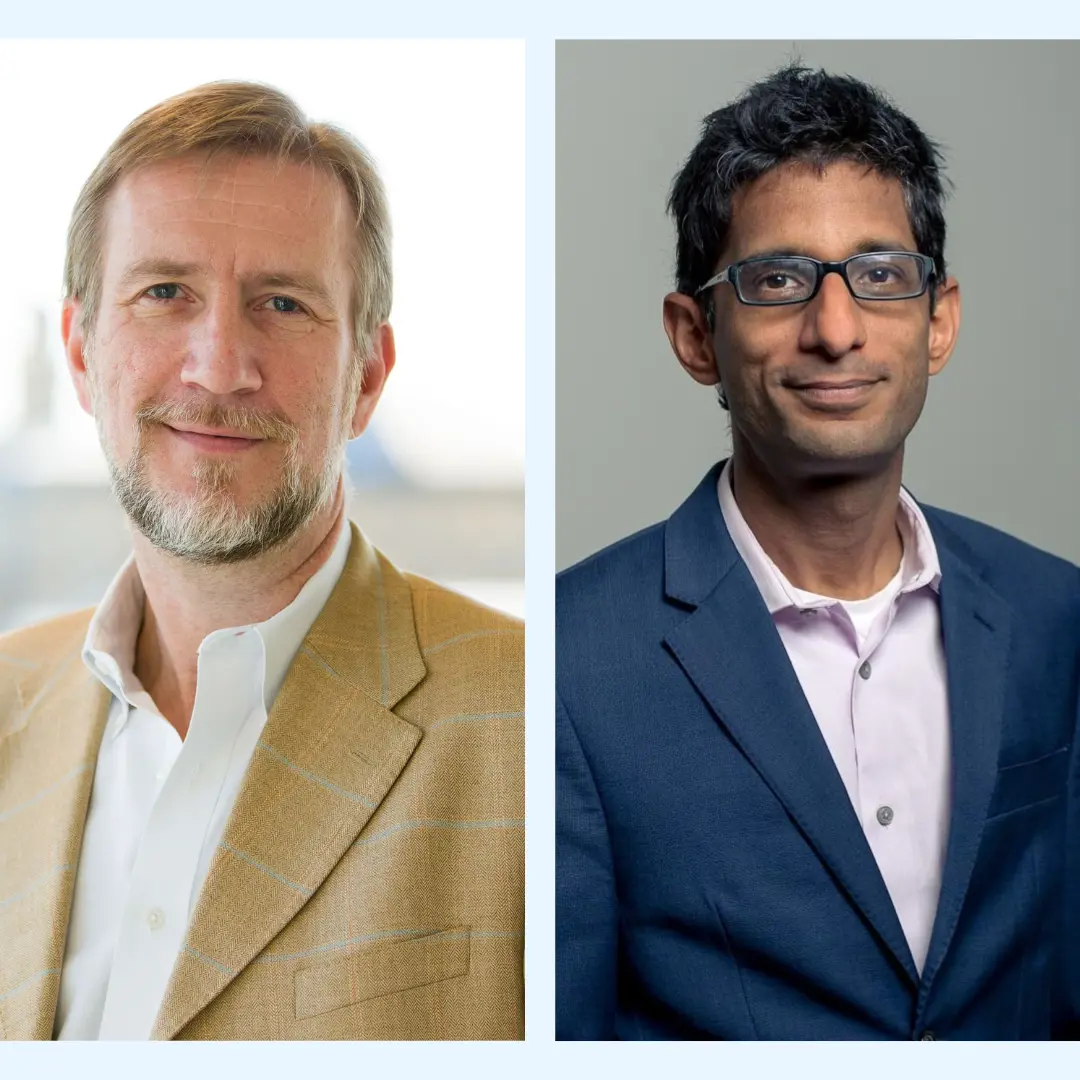
Gregor MacKinnon ’81 and Ray Dhirani ’98 have both built rewarding careers in international development, tackling complex issues including poverty, adolescent health and wellbeing, climate and the health of oceans.
MacKinnon is currently a director in the international development unit at Ecorys, a consulting firm in London, where he has worked since 2013. Over the past 40 years, he has directed more than £75 million (about $140 million Cdn.) in donor-funded programs across more than 30 countries.
His interest in the field started early. Before moving to Canada, he spent part of his childhood in Nigeria and Uganda, where his father taught law and his mother worked as an educational psychologist supporting school systems.
At UCC he found the same interests in the classroom. He studied the modern history of Russia and China with Michael Miller, and joined the debating club coached by Marshall Webb ’68, which took him to Model United Nations assemblies in Toronto and The Hague.
“That experience piqued my interest in the international sphere, more particularly in international organizations and the United Nations,” he says.
He followed it there. After UCC, he pursued his bachelor of political science at McGill and a master’s degree in international affairs at Carleton, then joined the United Nations Development Programme in Haiti as a junior professional officer. He arrived in 1986 during a period of political upheaval that saw four changes of government: two coups and two elections in two years.
“It was a very important and significant opportunity to try and contribute to help improve the lives of people in Haiti,” he recalls.
He moved to London in 1988 and spent eight years at the Commonwealth Secretariat before helping build the Commonwealth Business Council from scratch, working with governments and business leaders on trade and investment across Commonwealth countries. In Zambia, that meant establishing an advisory council that brought private-sector leaders together with the president and senior ministers to advise on policies to attract investment. He worked with several presidents in Zambia, and has stayed engaged with the country for more than 20 years.
“That was really rewarding, especially to see the progression where different governments took on board some of that advice and helped strengthen some of the policies,” he says.
At Ecorys, much of his recent work has been monitoring and evaluation — gathering evidence on whether donor-funded programs are achieving what they set out to do, and helping them adapt when they aren’t.
One program he currently advises focuses on healthy cities for adolescents in India, Vietnam, Colombia, Ecuador, Ghana and Senegal. It provides grants to organizations that support improvements in adolescent health and wellbeing in intermediary cities, in areas such as mental health, advocacy, skills training, amenities and public spaces. The program reaches more than 25,000 young people in places that rarely attract the funding capital cities do.
“I’ve been working in international development for 40 years, and I still learn new things every day,” MacKinnon says.
Dhirani is head of capital markets outreach at the Marine Stewardship Council and the Aquaculture Stewardship Council in London, where he works to get the finance sector engaged in the health of oceans and the blue economy.
He came to it from Wall Street. After UCC, he studied business and finance at Wharton, then spent nearly eight years at Merrill Lynch in New York, ending as a vice-president in trading.
He credits the College with the habits that made it possible.
“That career in economics and finance definitely benefited from the training at UCC — the way to schedule your work and to work hard and diligently, and also have a good mathematical background,” he says.
What changed was an afternoon in the Czech Republic, where he came across an outdoor art exhibit about environmental damage.
“It really got me thinking that I don’t want to spend my professional life and the bulk of my day working on something without much meaning,” he says. “What is it to flip that around and actually have that meaning in your work?”
He had no background in the field, so he moved to London in 2010 for a one-year master’s in environment and development at the London School of Economics.
The job he found afterwards was at WWF-UK, where he spent a decade and eventually led the sustainable finance team.
“I’ve been able to use my finance background, my training at UCC, and my knowledge, but using it in a way to try and make a difference in some of the really complicated, intractable areas of the environment,” he says.
One campaign he worked on helped push a British oil and gas company out of Virunga National Park, a World Heritage site in the Democratic Republic of the Congo, where the company had sought permits to drill.
When he started, the field barely existed.
“At the time, sustainable finance was still relatively small. I would definitely call it a niche,” he says. “Part of what I and others are trying to do is to make it mainstream, to really grow it and make it relevant so that it’s in the boardrooms.”
Today, his work is in the blue economy and blue finance space, focused on seafood, one of the world’s most traded commodities. He argues the case in terms a lender understands.
“If you’re making a loan to a fishing company over a long time frame, well, if the fish stock is going to be decimated, then your loans are less likely to be realized,” he says. “That is an interesting argument because it doesn’t rest on your climate or environmental views. It rests on what makes business sense.”
Dhirani realized after UCC how important it was to him to build service into his career, and he thinks others should consider it as well.
“If you’re going to spend seven, eight, 10, 11 hours a day working, to me it’s worth thinking about that service element,” he says.