



|
10/03/2026
The benefits of this innovative approach were illuminated during the two-week initiative and included personalized support for skill development and real-time program enhancements.
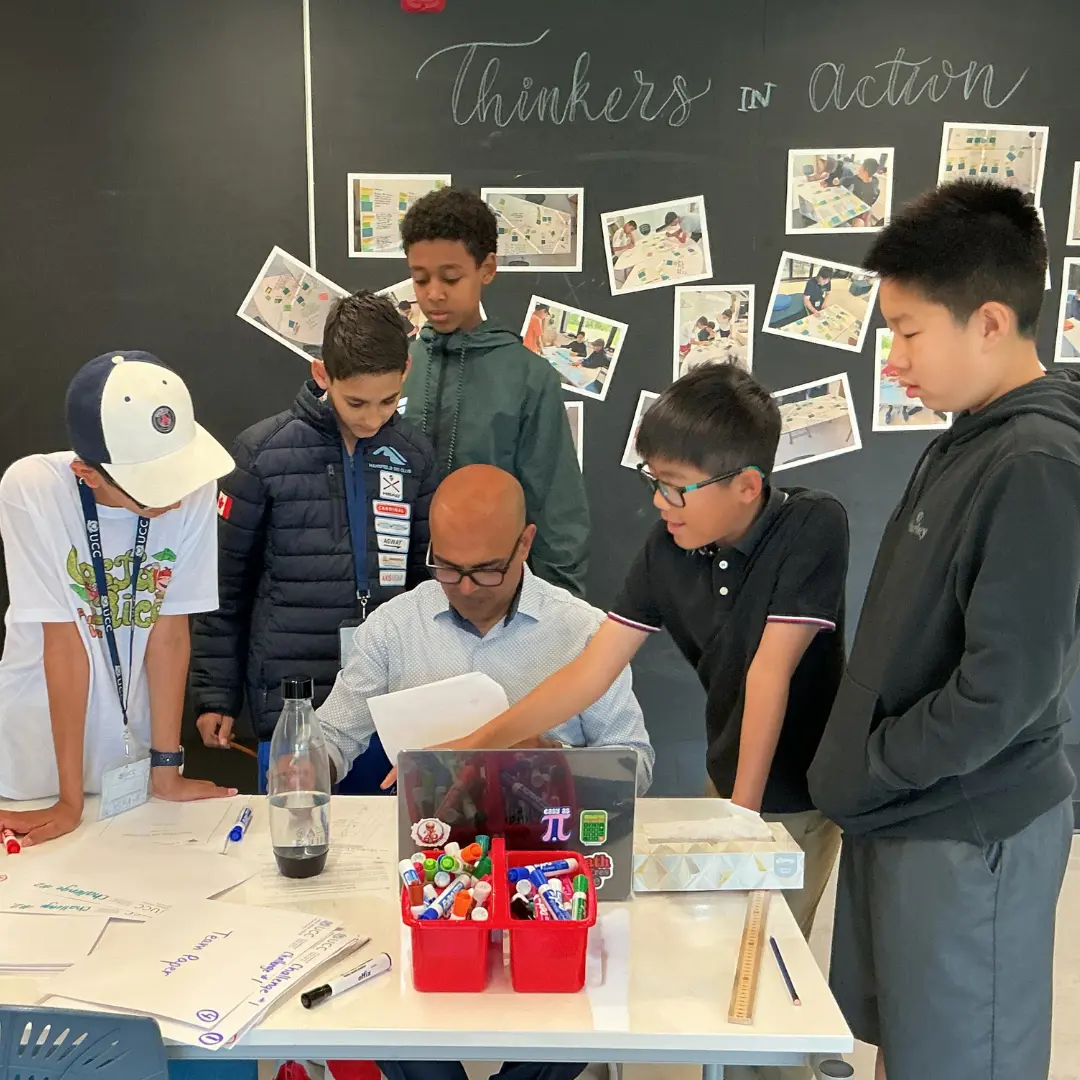
The summer camp was launched in collaboration with education startup kinship and brought together faculty and staff across the College, learning specialists, software engineers, and 25 UCC students from Years 6 and 7.
For Vice-Principal of Advancement Brendan Dellandrea ’01, the camp showcased UCC’s AI strategy in action.
“Only UCC could have created an opportunity like this,” says Dellandrea. “We had extraordinary teachers, some of the highest‑potential students in the country, and early access to a precision learning platform co‑founded by our own Old Boys.”
Co-founders Alan Gertner and Mike Stern from the Class of 2002 created kinship after recognizing that AI tools could help deliver the personalization of one‑to‑one support at scale in a classroom setting.
“Precision learning is this idea that we can now meet students exactly where they are in their learning,” says Stern. “We then teach to a student’s unique frontier of development through a combination of adaptive practice and great teachers in the loop.”
Upper School Mathematics Chair Bina Evans and Riyaz Ismail, subject learning leader for mathematics at the Prep School, worked alongside kinship engineers to build and refine the learning experience in real time. The curriculum was developed by Evans and Ismail in partnership with faculty from the Wernham West Centre for Learning and staff from the Information and Innovation team.
Specialists from kinship were on-site for the programming. This offered a unique opportunity to use student and teacher engagement to iterate and refine approaches. Says Evans, “We would run a session and then have a meeting. And almost immediately there would be changes made to the platform based on our feedback.”
For Ismail, it was like having an engineer in his pocket. “Somebody's able to just take the ideas in our heads and turn them into something that shows up on the student’s laptop. I found that amazing.”
Importantly, the goal was never speed. While some approaches to AI-enhanced learning focus on simply accelerating students through content, UCC's educators kept deeper learning as the overall goal.
“We're looking at developing a student, a human. And that involves more depth,” says Evans. While procedural fluency and skill development remain important parts of math, she says they are only one piece of the puzzle. With the technology helping identify gaps in understanding and providing targeted practice, the broader work of reasoning, problem-solving and conceptual thinking remains teacher-led.
“The tool is a tool. It's not replacing the teacher,” she says.
That approach aligns closely with UCC’s broader AI strategy, says Vice-Principal of Learning and Academic Innovation Dr. Julia Kinnear, who notes the College’s commitment to a human-centred, ethical approach to AI that augments teaching and learning.
“Well-designed tools, used intentionally and purposefully, can unlock huge progress for students,” she says. “But if they’re ill-designed or not thoughtfully deployed, they can actually have negative impacts on learning.”
The pilot’s results were promising, with measured gains in students' mathematical mindset, confidence and belief in their ability to tackle challenging problems. The team also saw encouraging results in teachers’ feelings of efficacy, a measure of their belief that they can understand and meet students’ needs. Research identifies teacher efficacy as one of the most important factors positively affecting student learning.
Building on the success of the summer pilot, UCC is now incorporating the same precision-learning approach into a Year 9 math class, for the obvious student learning benefits, and as a way for educators to study its impact over a longer period and in a regular classroom setting.
For Stern and Gertner, returning to UCC as a partner in this work has been meaningful.
Gertner credits much of the pilot's success to the educators involved. “It speaks to their ability to embrace something new while keeping the anchor on learning outcomes.”
“UCC has always tried to reinvent itself, rediscover and innovate,” says Stern. “It's an incredible privilege to be part of that.”